


What an Event Production Company Does
A polished event does not happen because the room looks beautiful at 6:00 p.m. It happens because dozens of decisions were made well before doors opened, each one tied to a business goal, a guest experience standard, and a detailed operational plan.
That is the real work of an event production company.
For executive retreats, leadership meetings, incentives, conferences, brand activations, and large-format corporate gatherings, the role goes far beyond decor or day-of staffing. A strong production partner shapes the event strategy, translates it into a creative and logistical plan, manages vendors and budgets, protects the client from risk, and runs the live environment with precision.
Managing Your Event Lifecycle from Planning to Execution
An event production company typically oversees both the visible and invisible parts of an event. The visible parts are what guests remember first: lighting, staging, signage, entertainment, registration, catering flow, branded environments, and the rhythm of the agenda. The invisible parts are what protect the experience: contract review, timing plans, staffing structures, transportation, contingency planning, audiovisual coordination, permits when needed, and payment reconciliation after the program closes.
According to the U.S. Bureau of Labor Statistics, event planners arrange all aspects of professional gatherings. That includes defining event scope, soliciting venue and service bids, coordinating rooms, transportation and food, organizing audiovisual equipment, managing guest registration, and reviewing event bills for payment approval. In other words, the job is equal parts creative direction and operational control.
For companies hosting premium experiences, this matters even more. When guests are senior leaders, top clients, sales winners, investors, or media, the margin for error becomes very small. Expectations are high, time is limited, and every touchpoint reflects on the brand.
An event production company is far more than a setup crew
The best partners act as strategic operators, creative directors, negotiators, and on-site leaders all at once.
Core event production services for corporate and brand events
The service range can be broad. Experience Epic Events describes event production work that includes brand activations, conferences, corporate meetings, government and municipal events, festivals, grand openings, movie premieres, custom production builds, trade shows, private events, and venue consulting and management. That range reflects a larger truth about the industry: production companies are often built to adapt across event formats while keeping a high level of control over guest experience.
For corporate clients, the most valuable services usually sit at the intersection of strategy, design, and logistics. A leadership off-site needs more than a ballroom and a projector. It needs agenda flow, executive pacing, breakouts that support real collaboration, arrival and departure plans, thoughtful food timing, strong room sets, and a visual identity that fits the company’s stature.
Common services often include:
- Venue sourcing and venue consulting
- Vendor bids and contract support
- Event design and branded environments
- Audiovisual planning and show flow
- Registration, guest communications, and staffing
- Transportation, room blocks, and logistics
- On-site production management
- Post-event reconciliation and reporting
A luxury-oriented production company also curates the intangible elements. It knows when a room should feel energetic and social, when it should feel private and executive, and when a high-touch moment will carry more impact than a larger but less considered one.
Event production process from strategy to on-site execution
A refined event production process gives clients structure without making the experience rigid. Experience Epic Events describes its planning formula in four steps: exploration, projection, implementation, and conclusion. That sequence is useful because it reflects how premium events are actually built, from business intent through final review.
Here is what that process often looks like in practice:
| Phase | Primary focus | Typical decisions | Key output |
|---|---|---|---|
| Exploration | Goals, audience, event scope | Purpose, attendee profile, destination, budget range | Strategic brief |
| Projection | Creative and operational planning | Venue shortlist, vendor bids, agenda framework, design direction | Proposal, budget, timeline |
| Implementation | Production and live coordination | Final logistics, staffing plans, AV cues, guest communication, rehearsals | Run of show and execution plan |
| Conclusion | Review and reconciliation | Invoice checks, KPI review, attendee feedback, next-step recommendations | Post-event report |
In the first phase, the company clarifies why the event exists. Is the goal sales acceleration, executive alignment, retention, recognition, market visibility, or investor confidence? That answer affects almost every later choice, from city selection to room layout to entertainment tone.
The second phase turns ideas into real-world plans. Venues are sourced. Vendor bids are requested. Budgets are shaped. Creative concepts are built into floorplans, show moments, dining experiences, transportation schedules, and staffing models. This is where a boutique, high-touch partner can offer major value because details begin to influence budget efficiency very quickly.
By the time implementation starts, planning should feel disciplined, not rushed. Production timelines tighten, final orders are placed, scripts are refined, signage goes to print, and contingency plans are documented. Then comes live execution, which is where strong preparation becomes calm on-site leadership.
On-site event production and live logistics management
The public often sees event production as the part that happens in the room. In reality, the room is only the last expression of a much larger operating system.
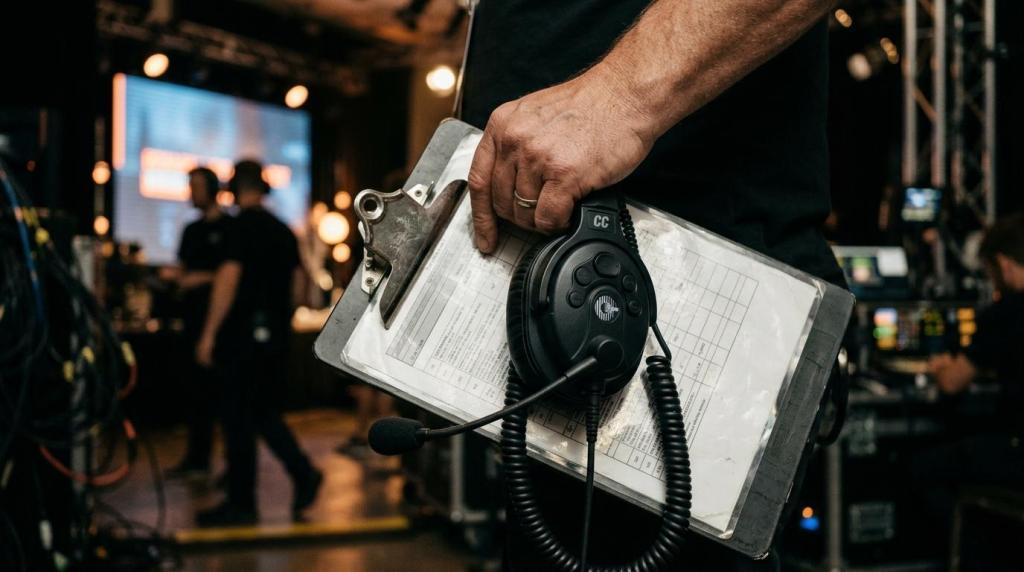
On-site teams are managing guest arrivals, registration, speaker readiness, audiovisual transitions, catering timing, room turns, transportation waves, VIP handling, brand standards, and last-minute changes. If a keynote starts late, the production team adjusts cues and meal service. If weather changes an outdoor plan, the team activates a backup. If an executive needs privacy, a room shift, or a revised walk-in, that adjustment happens quietly and fast.
This is also where experience shows. A premium production company does not simply react well under pressure. It builds systems that reduce pressure in the first place.
During live event execution, responsibilities often include:
- Guest flow: arrival experience, registration, wayfinding, and pacing between moments
- Technical direction: audiovisual equipment, stage management, lighting, sound, and show calling
- Vendor control: load-in schedules, catering timing, entertainment coordination, and service standards
- Leadership support: speaker prep, executive cueing, green room readiness, and VIP care
- Risk management: weather backup plans, staffing contingencies, safety checks, and issue escalation
For international programs or destination events, that operating discipline becomes even more valuable. Travel logistics, local regulations, destination-specific vendor norms, and cultural expectations can all affect execution quality. A destination management perspective helps connect local knowledge with global corporate standards.
Creative event production shapes brand perception
A production company is not only there to make an event run on time. It is there to make the event feel right.
That means translating a brand into atmosphere, movement, and memory. A sales incentive should feel aspirational and rewarding. A board dinner should feel discreet and confident. A product launch should feel sharp, cinematic, and media-ready. A leadership retreat should create room for candor, strategy, and renewal without losing polish.
This is where creative direction becomes business strategy in physical form. Lighting design affects mood. Room layout affects interaction. Music timing changes energy. Registration design influences first impressions. A well-produced event guides people emotionally without making the structure obvious.
For high-level corporate audiences, subtlety often wins. Not smaller, just more intentional. Premium event production is less about excess and more about control, resonance, and relevance.
Event success metrics and post-event review
A serious event production company should be able to speak about success in measurable terms. Experience Epic Events notes that event outcomes can be evaluated through attendee satisfaction, engagement levels, and predefined goals such as networking outcomes or sales targets. That is the right standard because appearance alone is not a business result.
Post-event work may include invoice reconciliation, internal debriefs, performance review by vendor, sponsor or partner analysis, guest feedback, and recommendations for future programs. The BLS also points to post-event bill review and payment approval as part of the planner’s role, which reminds clients that production responsibility continues after the lights go down.
Some metrics are straightforward, including attendance, budget variance, session participation, lead volume, and sponsor deliverables. Others are more strategic: did the retreat produce real alignment, did the incentive improve retention, did the meeting accelerate decision-making, did the activation create qualified brand attention?
That broader view is often what separates a vendor from a true production partner.
When companies hire an event production company
Some companies bring in a production company because the event is large. Others do it because the stakes are high.
An executive meeting with 80 senior leaders may require more production discipline than a conference with 800 attendees. A confidential retreat, a high-value client experience, or a market-facing launch can carry reputational weight that demands a seasoned external partner. Internal teams may own marketing, HR, communications, or operations, yet still need a specialist who can function as a fractional planner and production lead.
This model is especially effective for mid-market and enterprise organizations with lean internal teams. It gives leadership access to senior event strategy, destination expertise, contract awareness, and on-site command without building a full in-house production department.
What distinguishes a luxury event production company
Not every production company works at the same level.
A luxury-focused partner is defined less by price point alone and more by judgment. It knows how to protect a brand in front of senior stakeholders. It sees the difference between expensive and well considered. It manages vendors with authority, communicates with polish, and makes complex programs feel composed.
That standard usually shows up in several ways:
- Curated environments: refined venues, high-design details, premium hospitality, and strong sense of place
- Operational discipline: tight timelines, smart staffing, contingency planning, and careful budget control
- Executive presence: polished communication, discretion, and confidence in high-stakes settings
- Destination fluency: local insight for South Florida, Palm Beach, Miami, Fort Lauderdale, and international markets
- Business focus: event decisions tied to culture, revenue, retention, recognition, or brand goals
The guest may never see the spreadsheets, call sheets, production schedules, contract notes, or backup plans. They should feel the results anyway.
Questions to ask before choosing an event production company
Selecting the right partner is partly about creativity and partly about trust. A beautiful pitch matters, though the operating model behind it matters more.
A strong conversation with a prospective production company should clarify scope, leadership involvement, communication style, and how they handle risk. It should also show whether they can support the kind of experience your brand actually needs, not just the kind of event they most often sell.
Useful questions include:
- What parts of strategy, creative, logistics, and on-site execution do you manage directly?
- How do you approach event scope, vendor bids, and budget control?
- What is your process from concept through post-event reconciliation?
- How do you measure attendee satisfaction and engagement levels?
- What contingency plans do you build for weather, technical issues, or travel disruption?
- How do you adapt your production style for executive retreats, conferences, incentives, and brand activations?
The best answer is rarely the loudest one. It is the one that shows clear thinking, calm execution, and the ability to turn a business objective into a memorable, premium experience.

Leave a comment