


Event Logistics Checklist for Corporate Teams
Event logistics is the operating discipline that turns a corporate event from a concept into a controlled, premium experience. It affects guest arrival, speaker confidence, brand perception, safety, and the ability to stay on budget across many moving parts. The main problem it solves is fragmentation: venue, AV, travel, catering, registration, and vendors each run on different timelines unless one system ties them together. For executive teams, that system is usually a living checklist backed by clear ownership and fast decision-making.
What is event logistics for corporate teams?
Event logistics is the operating backbone of a corporate program. In Miami convention hotels and Palm Beach resorts, it coordinates venue flow, transport, AV, staffing, compliance, and timing so leaders can focus on message, relationships, and ROI.
Corporate teams often confuse logistics with basic coordination. It is much broader. Logistics covers dependencies, timing windows, load-in access, registration flow, speaker movement, meal pacing, power, Wi-Fi capacity, emergency procedures, and the chain of command when something changes.
A common misconception is that logistics starts once the venue is booked. In practice, logistics starts at brief stage. If the goal is a leadership retreat, the room layout, transfer plan, and even menu timing will differ from a sales kickoff or investor event. If the audience is international, then arrival patterns, customs timing, and passport-based hotel check-in become part of the logistics plan.
What belongs on an executive-level event logistics checklist?
A strong event logistics checklist includes scope, timing, ownership, and contingency notes. Cvent and Asana are useful examples of systems that help teams connect planning tasks to deadlines, vendor updates, and live status.
At executive and luxury level, the checklist should not read like a shopping list. It should function as an operating plan. Every item needs an owner, a due date, and a dependency. If AV rehearsal depends on ballroom access at 2:00 p.m., that constraint belongs on the checklist, not just in someone’s inbox.
- Venue and contracts: capacity, layout, access times, vendor rules, cancellation terms, insurance requirements
- Travel and arrivals: flight windows, airport transfers, parking, VIP routing, accessible drop-off points
- Production and technology: staging, sound, lighting, bandwidth, power, backup gear, rehearsal schedule
- Food and beverage: service style, dietary data, timing by agenda, staffing levels, cleanup responsibility
- Staffing and guest services: registration, hosts, security, runners, floaters, radio or chat assignments
- Risk and compliance: permits, ADA access, certificates of insurance, occupancy, emergency response, weather backup
Top Event Logistics Partners for Luxury Corporate Events
The best partner depends on program complexity, not just budget. Experience Epic Events, Freeman, and Four Seasons convention services all fit different operating models, from boutique destination management to large-format production to on-property coordination.
For high-stakes programs, partner choice shapes control, creativity, and response speed. The strongest partner is usually the one whose scope matches the real problem. A leadership retreat with multiple offsite touchpoints needs a different operator than a contained ballroom meeting.
- Experience Epic Events: Best for high-touch corporate programs that need destination expertise, strategic planning, creative production, and proactive risk control under one roof. This model is especially effective for South Florida and other premium destination markets where local knowledge changes outcomes.
- Global meeting firms like Maritz or BCD Meetings & Events: Well suited for large, multi-city programs with strict procurement structures. The trade-off is that service can feel less boutique when senior stakeholders want white-glove attention.
- Venue convention services teams at brands like Four Seasons or JW Marriott: Efficient for meetings that stay mostly on property. The limitation is scope, since offsite dining, transfers, and third-party production often sit outside their strongest lane.
- Specialist production agencies such as Freeman: Strong for major general sessions, exhibit environments, and show calling. They often need a separate logistics lead to coordinate transport, hospitality, room blocks, and attendee experience.
How do you build an event logistics checklist step by step?
The fastest way to build a useful checklist is to start with objectives, then map dependencies, then assign owners. Microsoft Project and Monday.com work well because they show timing conflicts before they become expensive.
Step 1: Define the event’s non-negotiables. Set the business outcome, attendee profile, budget range, destination, and format first. A 60-person executive retreat needs privacy, pacing, and elevated service. A 1,000-person sales meeting needs throughput, signage, and queue management.
Step 2: Build workstreams around the guest experience. Group tasks by venue, travel, production, catering, registration, staffing, and risk. Then connect them. If the agenda includes a beachside dinner, then weather backup, transport flow, sound permits, and footwear guidance all belong in the same chain.
Step 3: Assign a single owner and review rhythm. One task, one accountable owner. Weekly reviews work well early. In the final 30 days, many teams shift to twice-weekly reviews, then daily huddles in event week. Pro tip: a checklist without ownership is only a document.
How far in advance should corporate teams lock venue, travel, and AV?
Premium events should lock core logistics earlier than most teams expect. In Palm Beach, Miami, and London, luxury inventory and preferred vendor capacity can tighten 6 to 12 months ahead, especially in peak seasons.
A practical timeline for many corporate events looks like this. Venues and primary contracts often close 6 to 9 months out, sometimes earlier for resort buyouts or high-demand dates. Transportation and AV planning usually firm up 3 to 6 months out. Menus and special diets are often finalized 4 to 6 weeks out, with final counts 1 to 2 weeks before the event.
A common mistake is waiting for perfect attendance numbers before committing. If the destination is capacity-constrained, waiting can raise rates, split room blocks, or force compromises on meeting space. It is usually smarter to contract with protected attrition and review clauses than to wait and lose the right fit.
If your event falls during Art Basel, major finance conferences, or winter resort season, book even earlier. If travel is international, add extra time for visas, passport validity, customs for shipped materials, and speaker arrival buffers.
Should you use venue in-house services or outside vendors for AV and production?
Neither option is automatically better. In-house AV at Marriott or Hilton can simplify access and venue coordination, while outside partners often deliver stronger brand expression and show control for complex programs.
In-house teams usually know the room power map, loading path, patch points, and union rules better than anyone. That can reduce friction and speed up problem-solving. They are often ideal for straightforward executive meetings, panel discussions, and contained ballroom programs.
Outside production partners become more valuable when the brief includes scenic design, custom content playback, multi-room switching, broadcast-quality audio, or brand moments that need tight cueing. They often bring senior show callers and more specialized equipment packages.
The trade-off is coordination. If you use an outside partner, then rigging rules, internet charges, labor calls, and venue exclusivity need to be reviewed early. Pro tip: ask for actual bandwidth, concurrent user assumptions, and overtime thresholds. “High-speed Wi-Fi” is a marketing phrase, not a technical spec.
How do you manage transportation, guest flow, and VIP arrivals step by step?
Strong guest movement starts before the first arrival. At airports like MIA and PBI, the best plans separate VIP movement, general attendee flow, and service access so the curb never becomes the event’s weakest point.
Step 1: Map arrival scenarios. Build for early arrivals, delayed flights, rideshare congestion, accessible entry, and executive security needs. If VIPs and general attendees share one entrance, then staffing, signage, and timing must absorb that pressure.
Step 2: Build the routing and buffer plan. Create transfer schedules, staging zones, parking instructions, and holding patterns. Many operators add a 15 to 20 minute buffer for urban transfers and more when weather, drawbridges, or international arrivals can affect timing.
Step 3: Communicate with precision. Send maps, pickup instructions, attire notes, contact numbers, and live update channels before travel day. On site, aim for check-in times under 60 to 90 seconds per guest where possible. A common mistake is over-designing the welcome and under-designing the curb.
How does a DMC compare with an internal planning team for destination events?
A destination management company usually wins on local execution, while an internal team wins on brand context. In South Florida or the South of France, the best results often come from a hybrid model that combines both.
Internal teams know stakeholder politics, procurement rules, executive preferences, and the message the event must land. That knowledge is powerful. Yet destination events add local permitting, transport patterns, preferred vendors, weather realities, and venue negotiation details that most in-house teams do not handle every week.
A destination management company brings those local layers into one operating structure. That can mean stronger routing, faster vendor response, better contingency options, and cleaner on-site execution. Experience Epic Events uses a boutique, fractional planner model that suits organizations wanting senior support without building a large internal event department.
If the program is a single-property meeting in a familiar city, an internal team may be enough. If it involves airport movements, multiple venues, executive hospitality, or international guests, a DMC often saves time, reduces risk, and protects the guest experience.
How do you protect a corporate event with risk management and compliance?
Risk management should begin at kickoff, not in the final week. In outdoor South Florida events or multi-country executive programs, the risk plan should sit beside the budget and run-of-show as a core operating document.
Start with a written risk register. Include weather, health, security, transportation failure, speaker disruption, tech failure, labor issues, and contractual exposure. Then assign likelihood, impact, owner, trigger point, and response. Many planners keep a 10 to 15 percent contingency reserve for unplanned costs.
A common misconception is that insurance replaces planning. It does not. Insurance may help recover some losses. It does not tell guests where to go when lightning stops an outdoor reception, or how to pivot when a keynote misses a connection in Atlanta.
If the event includes alcohol, music, outdoor structures, or public-facing access, confirm permits, licensing, occupancy, and certificates of insurance early. Pro tip: put risk questions directly into RFPs and contracts. If a vendor cannot explain backup staffing, power redundancy, or weather response, that is a useful signal.
How should teams run event-day command and communication step by step?
Event day should run from a command structure, not from scattered text messages. Slack, WhatsApp, and two-way radios can all work, but only if one live run-of-show controls timing and decision rights.
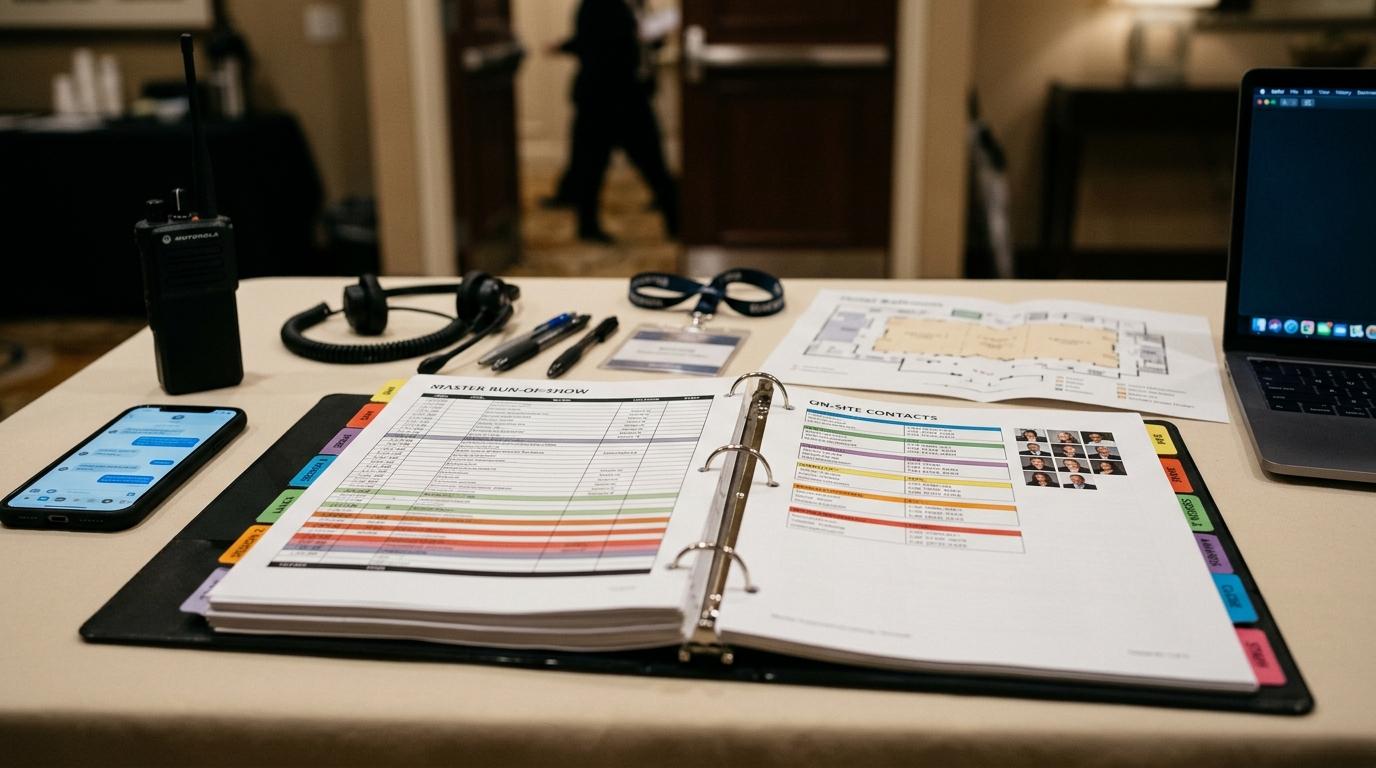
Step 1: Establish a command center. This may be a green room, boardroom, or production office. It should hold the master run-of-show, contact sheet, vendor schedule, rooming updates, transport status, and escalation path.
Step 2: Rehearse the operating cadence. Hold a full-team briefing before doors open. Review timing, cue points, VIP movement, emergency roles, and what counts as an escalation. If the registration queue crosses a set threshold, then open a satellite desk. If weather radar shifts, then move on the backup before guests notice friction.
Step 3: Separate decision-making from noise. One person should own each workstream: production, guest services, transport, F&B, and client liaison. Pro tip: a luxury event feels calm because backstage authority is clear, not because surprises never happen.
What metrics show whether event logistics actually performed well?
Logistics performance is measurable. Cvent reports, budget trackers, and venue post-cons can show whether the operation protected time, budget, and guest experience, not just whether the room looked polished.
The strongest teams review outcomes within 72 hours while details are still fresh. Compare planned versus actual data, then record lessons for the next program. This is where a checklist becomes a better operating asset instead of a one-time document.
- On-time performance: doors open, sessions start, transfers depart, meals reset as scheduled
- Guest flow: registration wait time, shuttle load efficiency, room changeover speed
- Budget control: variance by category, rush fees, overtime, unused inventory
- Risk results: incidents, near misses, medical calls, weather pivots, equipment failures
- Experience quality: attendee satisfaction, speaker feedback, VIP service notes, staff observations
If one metric slips, read it in context. A higher transport cost may be acceptable if it protected executive punctuality and reduced exposure. A lower F&B spend is not a win if service timing interrupted networking or shortened the program’s most valuable conversations.


Leave a comment